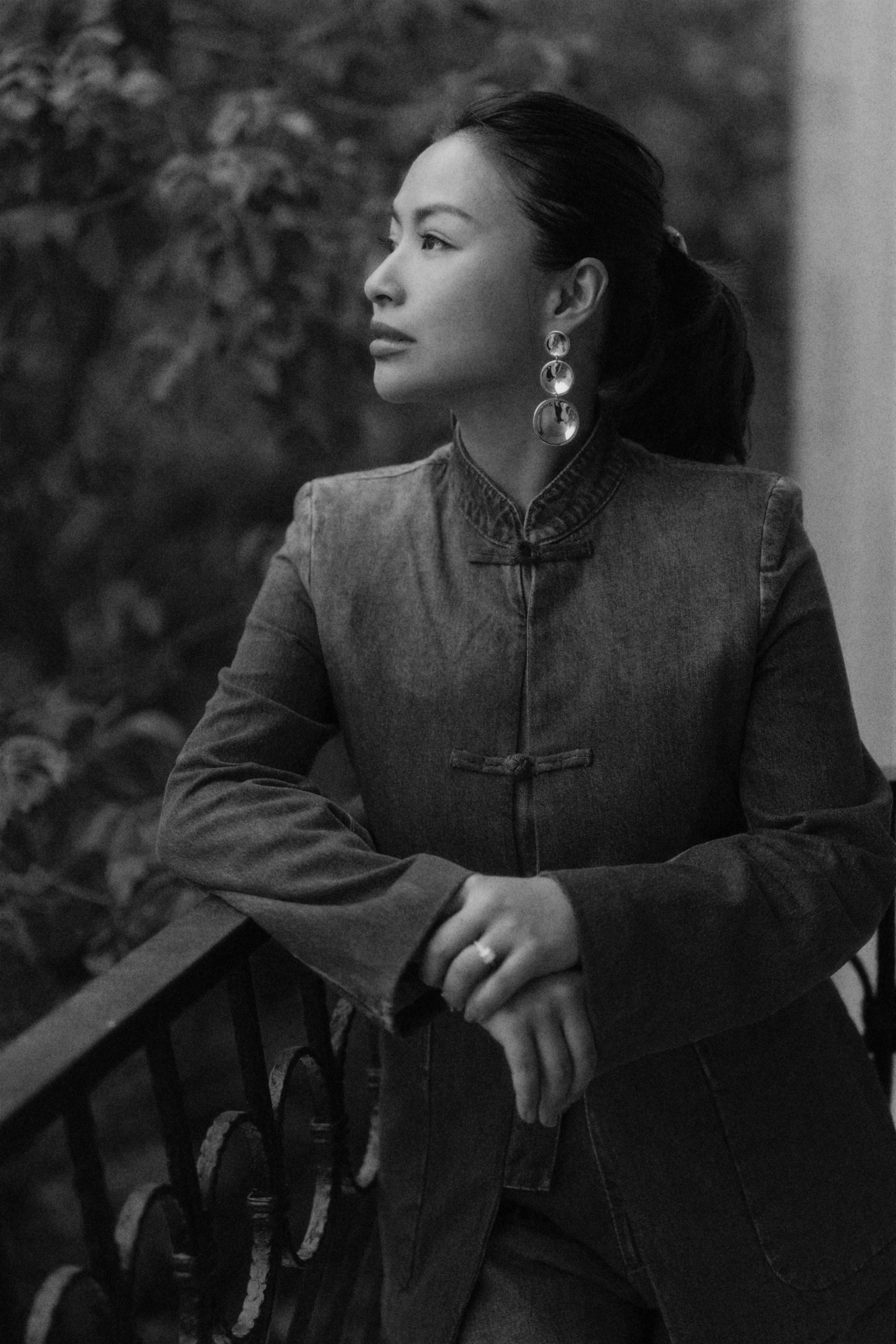
Joyce Lei has spent her life in pursuit of a single subject: the human being in all of its depth, contradiction, and beauty.
She was raised across Hong Kong, Taipei, Shanghai, Toronto, and London, moving through childhood in a sequence of arrivals and departures. It was a formation of rare privilege and of a particular solitude. She had access to worlds most people never see from the inside, and she belonged completely to none of them. She learned early to see beneath the surface of a life. And she learned, just as early, what it costs to perform one.
Growing up, she was surrounded by Chinese antiques, objects from her own lineage made with extraordinary devotion and craft. She understood early that things made with that quality of intention hold more than their physical form. They hold time. They hold history, story, and the evidence of life. It is precisely their imperfections that make them irreplaceable. For Lei, art has always been a study of people. We are not made to be flawless. We are made to be singular.
Her entrepreneurial life began at eighteen. For twenty years, vintage dealing was closest to her heart, an extension of a lifelong passion as a collector drawn to objects of rare quality and enduring significance. For Lei, luxury has never been a question of price. It is a quality of attention, a way of honoring existence itself. She moved across Europe, Asia, and North America, working with collectors and private clients who shared that understanding.
Significant business losses followed, bringing her twenty year chapter to a close. Lei came to understand them as the inevitable consequence of a sensitivity that had outgrown that particular position and circumstance. She had been absorbing what was not hers to carry, and the losses were simply the moment that became undeniable. It was the end of keeping up. And the beginning of understanding what rest actually meant.
She has spent decades accumulating what she once needed most: ways of seeing in the dark. Through years of dedicated study in psychological astrology, human design, and somatic and energetic modalities, she built a language for what most people can only feel. She brings all of herself to meet all of the person in each session.
At the heart of this teaching is something Lei recognized immediately as the articulation of what she had always known: that every human being contains multitudes. This is the very nature of being human, and it is what makes us, each of us, genuinely singular.
This is the understanding from which all of Lei’s work proceeds. She guides people through the process of coming to know themselves fully, exactly as they are. What becomes possible, in that knowing, is rest. It is the work that asks something of both the guide and the guided. And it is the work that Lei has been preparing for, in one form or another, her entire life.